-
Please help Walk+Bike+Roll Randolph by responding to our latest survey on pedestrian safety. You can access the survey here. The survey will be accepting responses through August 15th.
-
If you are trying to cross Main Street by Kimball Library, you now have a little extra help. Thanks to a grant from AARP, a flashing pedestrian beacon known as a Rectangular Rapid Flashing Beacon (RRFB) is now in place and operational at that crosswalk. Walk+Bike+Roll Randolph (WBRR), a local group advocating for safer conditions for walking and bicycling, secured the grant funding in 2025. The Town of Randolph agreed to work with WBRR on installation of the RRFB.
The Town incorporated installation of the RRFB with other sidewalk work planned for the intersection of School Street and Main Street. Local contractor WB Rogers did the curb and sidewalk work, and the Randolph Highway Department installed the beacon poles and equipment with help from Harmony Electric to make the final connections. Kimball Library Director Amy Grasmick had this to say about the new beacons, “We’ve heard from library patrons about a lot of near misses in the Main-School St intersection. It’s so great to have a safer way to cross the street.”
RRFBs are included in a list of “proven safety countermeasures” identified by the Federal Highway Administration. They have been shown to significantly increase pedestrian safety and are used widely in Vermont and in the U.S. The solar-powered beacons are activated by pushbutton and flash for a set amount of time before turning off. They do not have the same weight as a traffic signal but are meant to catch the attention of drivers so that they stop for people trying to cross the road.
WBRR has been working over the past several years to make improvements to the safety and comfort of people walking in the downtown. They participated in the local committee that developed the Town’s Walk/Bike Master Plan, they successfully wrote a grant application to secure funding for the feasibility study of sidewalks on Weston St., Park St. and South Main St. to Shaw’s, and they worked with the Town’s deputy tree warden to secure grant funding for new trees in the downtown. They are collaborating with Chandler to offer a free Ebike lending library from August 5th through the 19th. More details about how to sign up to try an ebike will be available soon.
In addition to the RRFB, the AARP grant funding was used to purchase additional in-street pedestrian signs (the ones seen around town at key crosswalks) and to purchase the pedestrian safety flags now located at two Main Street crosswalks.
WBRR is always interested in feedback on ways to make Randolph safer and more attractive for people walking and bicycling. They currently have a survey out to gauge how the public feels about the RRFB and the other AARP-funded initiatives. The survey can be accessed online at https://forms.gle/vFPZCZyBCyPASoPx7.
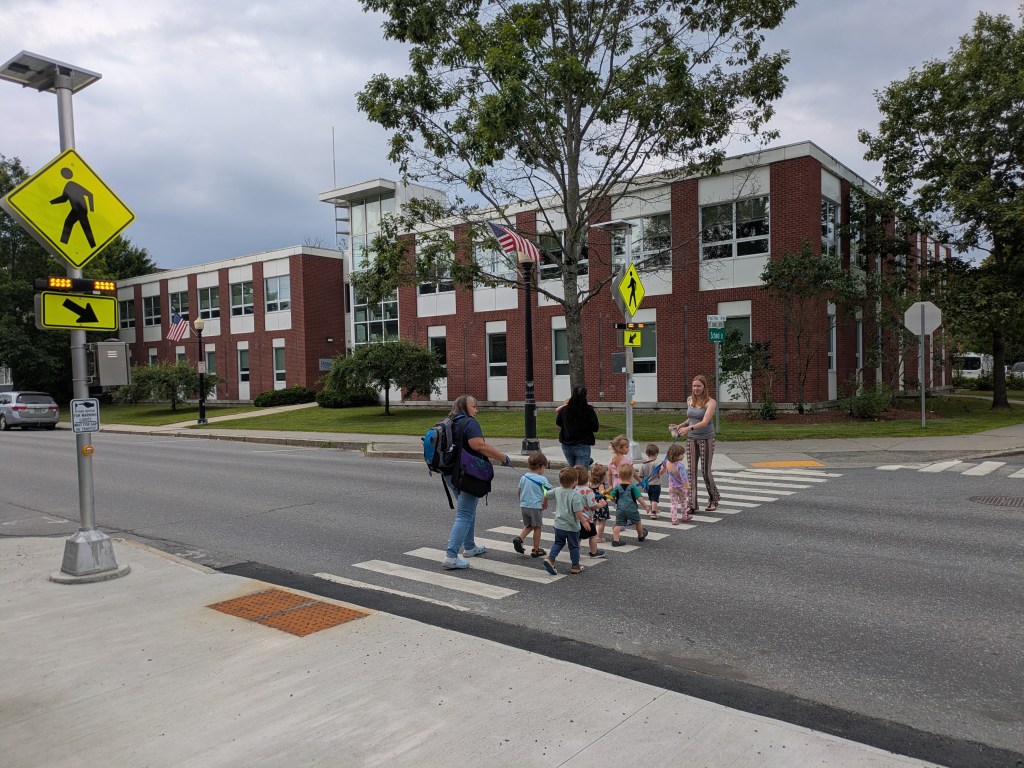
Pre-schoolers using the new flashing beacon at the Main St. crosswalk by the Library.
-
We strongly recommend listening to this episode of The War on Cars to understand how the car culture of the U.S. was intentionally created by car companies back in the 1920s. Rather than the normal process by which capitalism is supposed to occur – with the car industry meeting the demand of the public for cars, they modified cities so that people had to use cars to get around to increase the demand for cars.
-
If you need context about what this post is addressing, please read previous posts about the pedestrian beacon to get up to speed. This is an update.
We met with the Randolph Selectboard on July 10 to try to get them to overturn the town manager’s decision to decline acceptance of our $15K donation of a pedestrian beacon at the School St. crosswalk in front of the library.
Their main objection was that we didn’t follow the town’s grant policy. We argued that we had worked with the acting grant administrator at the time and he never told us to follow the policy nor did he indicate we shouldn’t apply for the grant that we ended up receiving from AARP.
We presented a history of how we this project developed. Several citizens spoke in favor of the town accepting the donation, citing how difficult that crossing is.
Other issues brought up by board members were: possible vandalism, compliance of the beacon with the town’s walk/bike master plan (which hadn’t been received as of the July meeting), and the possible impact of the flashing beacon on nearby residents. In the end, the board took no action and said that “someone would be in touch” with us. If you want to watch the video of that meeting, you can access it here – https://www.orcamedia.net/series/randolph-selectboard.
Note that a copy of the draft Walk/bike master plan is now available and it mentions RRFBs (flashing beacons) as a safety measure for several crosswalks including the one at the library. However, as of now, this plan has not been adopted or endorsed by the Town.
After waiting at least a week with no contact from the Town or Selectboard, Maryann reached out to Trini (board chair). Trini asked for a copy of the grant agreement we have with AARP and we provided that. No further requests for information or contact have come from Trini.
To address the visual impact question, we talked with Ann Howard, who works with seniors in town. She helped us develop and distribute a survey to the residents of Randolph House asking their opinion. We also held a meeting at Randolph House at which around 20 of their residents came to talk with us. All were in favor of the pedestrian beacon and no concerns about the visual impact were expressed. We did reach out to the resident of the white house between the library and Chandler and she is not in favor of the beacon. We passed on the Randolph House info to Trini.
One issue raised by the Town manager in a previous meeting was the level of insurance available during construction of the flashing beacon. We reached out to AARP about this. We applied for this grant in partnership with RACDC, who carries appropriate levels of insurance. We plan to make sure that the contractor who will do the actual installation has adequate insurance and RACDC will be the contracting entity, so we feel like we have addressed this issue.
We still feel like the flashing beacon is an important safety improvement for people crossing the street by the library. We don’t know what to expect at this week’s Selectboard meeting. We are on the agenda for this Thursday’s 8/14/25 Selectboard meeting starting at 5:30 PM. There is no way to know when our item will come up. Please plan to attend if you want to offer support either by your presence or by speaking to the board directly.
-
Update on Flashing Beacon Donation
The chair of the Randolph Selectboard asked us to defer discussion of the rectangular rapid flashing beacon (RRFB) that we want to donate to the town from the June meeting to this week on Thursday, July 10. You can see the details about the situation here – https://walkbikerandolph.org/2025/06/10/selectboard-to-consider-donation-of-15k-in-improvements/.
On Monday morning, 7/7/25, we met with the chair (Trini Brassard) and with John Shangraw, the Town highway supervisor, to review the proposed location and to hear their concerns. Trini raised some questions about having an outside party in charge of putting in infrastructure that the Town will then own. We don’t feel like that is insurmountable. We are willing to collaborate with the Town in whatever way they feel comfortable to make this work.
Trini also expressed concern with having flashing lights in the downtown i.e. what will the public think of them. Of course, that is impossible to tell and it is unlikely that 100% of the public will be in favor of them (there is rarely, if ever, 100% support of anything that government does). However, we see the almost certain benefit of the flashing beacon signs as outweighing the grumblings of a small minority. That is really the crux of the question before the board on Thursday. Do they support the idea of pedestrian safety enough to outweigh minor administrative concerns and minor impacts to snow removal practices by the town crew?
Note that the Federal Highway Administration lists RRFBs as a “proven pedestrian safety countermeasure” with up to 47% reduction in pedestrian crashes and an increase of 98% (almost doubling) in driver yielding rates. This is solid data that these features work to make it safer to walk.
John was somewhat ambivalent about the signs, although with a short staff, he is leery of anything that adds to his workload. That is understandable.
We hope that a majority of the Selectboard will see the benefit of this safety improvement for which we have secured funding and whose construction we will oversee. Please consider attending the meeting in person or virtually to express your feelings. -
Please note that based on recent developments, the flashing beacon discussion with the Randolph Selectboard scheduled for Thursday 6/12 is being delayed until July. Stay tuned for more updates in the near future and thanks for your support.
-
Since 2022, Walk+Bike+Roll Randolph (WBRR) has been working steadily to fulfill its mission to make Randolph safe for people walking or riding bicycles. In March of 2025, we applied for an AARP Community Challenge Grant. Most of the project budget is for the installation of a Rectangular Rapid Flashing Beacon (RRFB) at the Main Street crosswalk in front of the library. An RRFB is a pedestrian push-button actuated flashing yellow light that supplements regular crosswalk signs to bring more attention to a marked crosswalk at an uncontrolled (i.e. not at a STOP or YIELD) location. (see photo below).
This crosswalk was chosen for several reasons. We were aware that the Town requested 4 RRFBs as part of the state Class 1 paving project currently scheduled for 2027. This crosswalk serves the dense residential area along and adjacent to School Street. The Town Recreation area is accessed from School Street. Kimball Library and Chandler Center for the Arts are in close proximity to this crosswalk as well as Randolph House with many residents who don’t drive.
The idea of using RRFBs at key crossings in the downtown has been a common theme during the many public outreach opportunities facilitated by WBRR. RRFBs are considered to be a “proven safety countermeasure” by the Federal Highway Administration and are widely used in other Vermont communities such as Northfield, Lyndon, Thetford, Vergennes, Swanton and Jericho.
During the grant application process, we worked with Jeff Grout (Town Grant Administrator at the time), who had been identified as our town liaison, throughout the grant process. We met with him in February to go over the details of the grant and to discuss the approach of WBRR applying for the grant directly, with RACDC as our fiscal agent. Jeff indicated support for the concept of the improvements. We tried to get a letter of support from the Town, but ran out of time before that could be finalized.
We had heard from the Town about issues with capacity for managing grants, so in this case, we applied directly so that we could manage all aspects of the grant, including fiscal responsibility, hiring a contractor and overseeing their work. This grant requires no matching funds from the Town. We were aware of the Town grant policy, but at no time did Jeff indicate we should be following that policy since no town funds or administration time was required.
In May, we were very excited to receive word from AARP that our project was one of 380 grants selected from over 3500 applications received in this competitive nationwide solicitation. Our next step was to go to the town for formal acceptance of this $15K donation of the RRFB and to discuss how to work together to get the RRFB installed this summer/fall (the grant funds must be used by the end of 2025). We were shocked and disheartened to have the town decline to move forward with installation of the RRFB. We had a second meeting with the Town to try to understand why they would refuse this donation.
The Town Manager, Trevor Lashua explained that because the walk/bike master plan being completed by the Regional Planning Commission isn’t done yet, that this offer of funding is coming “out of sequence” and that the town can’t adequately plan for it or know that it is the highest priority. He talked in vague terms of projects being worked on over the next 3-7 years. He also brought up an ill-defined concern about liability (the Town has insurance, and we would require the contractor installing the RRFB to have adequate liability insurance).
We tried our best to counter these arguments, but in the end, the Town was still at a “No”. They acknowledged that we could appeal to the Selectboard, which we were prepared to do. We submitted the request to get on the next agenda, which is this Thursday, June 12. The meeting starts at 5:30 at the Randolph Town offices. There are a number of other items on the agenda before ours, but sometimes the board re-orders items. Please consider attending the meeting in person, or at least via Zoom, to voice your support for the Town accepting this $15K donation of important safety infrastructure for people crossing Main Street. If you can’t attend, please consider emailing all the board members. Their email addresses may be found at https://tinyurl.com/bdh5h93j
-
You may have noticed that the in-street pedestrian signs that were located at 4 crosswalks in the downtown have been removed. Our Walk+Bike+Roll Randolph group (WBRR) secured grant funding and donations for these signs and worked with the Town of Randolph for approval to install the signs. The locations were chosen where known pedestrian safety concerns had been identified through public meetings and other input.
These signs are used in numerous VT communities and around the U.S. Their purpose is to draw driver’s attention to the crosswalk and to slow traffic as it traverses these critical locations. Each of the locations had challenges around keeping the sign relatively close to the crosswalk while allowing turning vehicles (especially larger ones or those with trailers) adequate space. We responded to feedback and adjusted sign locations several times. Overall response to the signs was positive.
However, recent concerns resulted in the Town asking us to temporarily remove the signs to reassess where they can be located to provide continued safety for people walking, while minimizing conflicts with vehicle traffic. We look forward to having those discussions with the Town and coming up with a plan to redeploy the signs in the near future. WBRR is committed to education and infrastructure changes to make Randolph safe for people using bicycles or walking. If you want to learn more about WBRR, please visit our website at walkbikerandolph.org. -
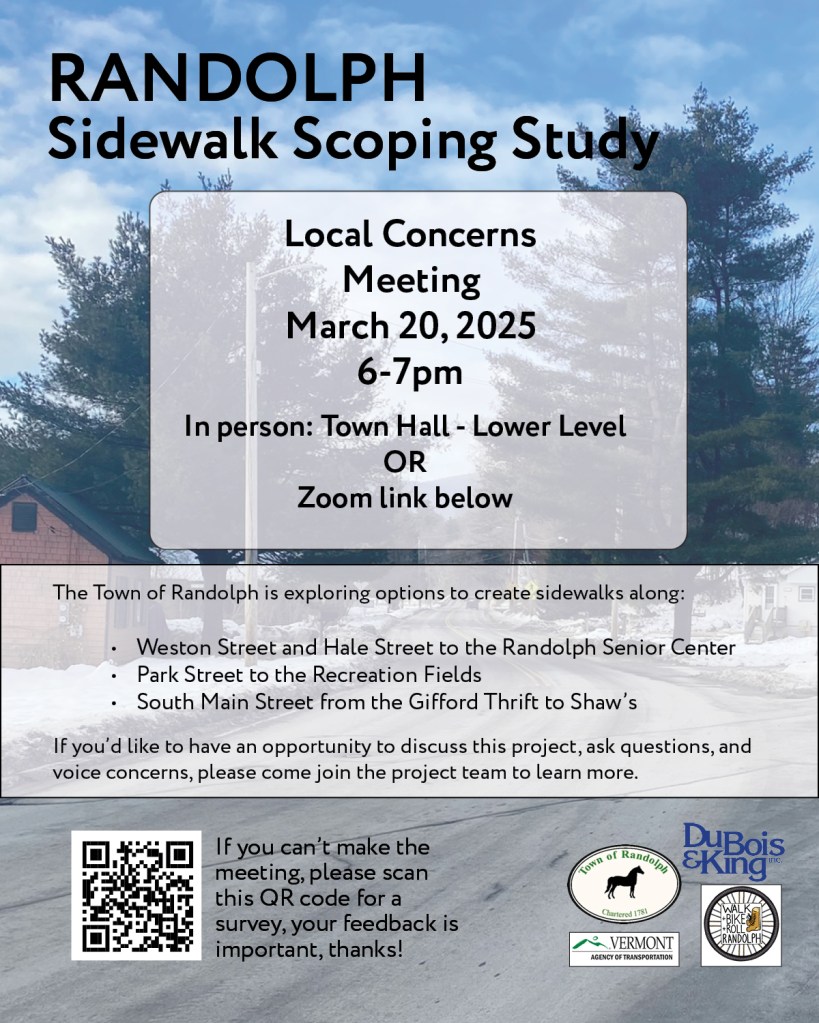
The Town of Randolph is exploring options to build sidewalks at three project sites in Randolph: along Weston Street and Hale Street to the Randolph Senior Center, Park Street to the Recreation Fields, and South Main Street from the Gifford Thrift Store to Justin Morgan Marketplace (Shaw’s).
On Thursday, March 20th from 6-7pm, there will be a local concerns meeting in the lower level of the Town Hall, where feedback will be gathered on what the community would like to see in these three project locations. Please come join us for an opportunity to discuss this project, ask questions, and voice your concerns. If you can’t make the meeting in person, please join us via zoom: https://us02web.zoom.us/j/86317147808?pwd=JayrOAffjpVgYsfrweuTk0NvvaERyL.1or call in: 646-931 -860
Meeting ID: 863 1714 7808
Passcode: 987804If you are unable to make the meeting either in person or virtually, please fill out the survey by following this link: https://forms.gle/YGENWE6QFhhpYkid7
Your feedback is important. Thanks for participating in any way you can!
-
In the past couple of months, our central Vermont community has experienced three tragic traffic crashes (2 in Randolph and 1 in Chelsea) resulting in 3 deaths and 1 person with serious injuries. All of the people involved, as well as the first responders, have surely been traumatized by these events and deserve our support. These events highlight how dangerous crashes involving motor vehicles can be.
Two of the three deaths were people who were walking and were struck by vehicles. We don’t know all the details of these crashes yet, but both emphasize that when a person walking is hit by a vehicle, the consequences are serious and often fatal. That’s why a number of years ago, the Vermont legislature created a definition of “vulnerable users” that includes people walking, bicycling or using wheelchairs or other assistive devices. There are several laws related to how people driving vehicles must interact with vulnerable users. Just last year, an amendment to one of those laws made it a requirement that when a vehicle is passing a vulnerable user, they must give them a minimum of 4 feet of clearance to do so safely.
Walking in a downtown environment should not be a dangerous activity. There are many factors involved. Randolph’s downtown has a better than average network of sidewalks and crosswalks. Thanks to the vision of previous town government leaders, a streetscape project took place in the mid-1990s and created some of the better features of the downtown, namely the bump outs of the curb at intersections and much of the sidewalk along Main Street. The bump outs, such as at the intersection of Main/Merchant’s/Salisbury help to slow traffic by narrowing the roadway and also make for a shorter crossing for people walking while making it easier for people waiting on the corner to see and be seen by traffic. While features from that project endure, more can be done to make our downtown safe for people outside of vehicles.
Town and Advocates Work Together
The Town has taken some recent positive steps. They enlisted the help of Two Rivers Ottauquechee Regional Commission to develop a walk/bike master plan. Over 200 people responded to a public survey about the current state of walking and bicycling in Randolph. A complete inventory was made of all existing sidewalks in Randolph. Speed and volume data was collected at key locations on all the entry points to Randolph’s downtown. The Town applied for and was awarded a grant to study the feasibility of new segments of sidewalk. The locations being studied are the missing segment out to Justin Morgan Plaza (Shaw’s) from the Gifford Thrift store, all of Weston St. with a spur to the Senior Center, and the segment of sidewalk from near Wallace Hill Road out to the Town recreation area on Park Street/12A. That study has just started with DuBois and King doing the work. The Town also replaced some key segments of sidewalk last fall. This included a critical section adjacent to the Main Street entrance to Randolph House. The Town marks crosswalks with fresh paint each year and removes snow from them in the winter.
In addition to efforts led by the Town, Walk+Bike+Roll Randolph (WBRR) has also been working to make a difference. WBRR is a citizen led advocacy group whose mission is “working towards a Randolph in which all members of our community have access to our public spaces and can walk and bike safely and comfortably”. Our group started forming in the first half of 2022 and has been gathering momentum since then. Last year, WBRR purchased three in-street pedestrian signs that were deployed at key crosswalks in the downtown to draw attention to them and to help slow traffic. These signs were well-received by the community, with almost universally positive feedback. When one went missing, many citizens expressed notes of concern before it was located. When a second sign was stolen towards the end of the fall and never found, several generous donors provided enough funds for a replacement. Ideally, the Town will kick in funds to purchase 1 or 2 more of these relatively low cost safety improvements that will be redeployed when snow plowing season is over.
Creating a safe Environment for Walking and Bicycling
Creating a safe place for people to walk, roll, and ride depends on two main components. One is providing quality infrastructure so that all transportation users have adequate and safe ways to travel. The second is for everyone on the road to operate safely. This means that drivers go no faster than the posted speed, they are focused on the task of driving, and they are aware of all possible road users. People walking or bicycling must follow the rules of the road. This “behavior” side of the equation is much more difficult to influence. It is relatively easy to build infrastructure given the will and adequate funding. Getting people to do the right thing when behind the wheel of a powerful vehicle is not as easy. That’s why there are over 40,000 traffic deaths in the U.S. each year. The U.S. has the highest rate of traffic deaths among industrialized countries worldwide.
WBRR has heard many stories about – and experienced first hand – close calls when either walking or riding a bike in Randolph. I have been cut off by a car going from Central St. to Park St. at the junction of 12 and 12A. I have had cars roar by me as I walk along the road because the sidewalk was too icy. Cars routinely cut the corner going south from Main Street onto Pleasant Street (by the gazebo), risking a crash with people in the especially long crosswalk who are trying to cross the street. A mother and young child were hit by a car at this crosswalk in 2023, luckily with no resulting injury. Drivers cutting this corner also pose a threat to vehicles coming out of Pleasant Street. People have also reported speeding traffic coming down the South Main Street hill as they use the crosswalk by the Playhouse Theater. Let’s all slow down and look out for one another so we prevent further injuries or fatalities.
Hopefully, the Town will continue investing regularly in improvements to the infrastructure. Some other ideas received from the community are: better lighting at crosswalks for people walking at night; push button flashing warning lights at key crosswalks, especially those used by school aged kids or elderly people; modifying the Main St./Pleasant St. intersection to keep cars from cutting the corner while still allowing large trucks to make the turn; striping our travel lanes slightly narrower and putting in white edge lines to help reduce vehicle speeds and also give drivers better visual aids at night. The City of Burlington recently joined many other U.S. cities and lowered their city wide speed limit to 20 MPH. While we may not be ready for that, this is the type of visionary, inclusive thinking that is needed to make Randolph a safe place to walk or ride a bike.
Safe Driving is Critical
As a community, we all need to do our part when behind the wheel. It is not hyperbole to say that we are in the midst of an epidemic of aggressive driving. When you are behind the wheel of a vehicle that weighs anywhere from 2500 to 4500 pounds, you have the benefit of all the safety features surrounding you, but you are a lethal threat to anyone who isn’t driving and speed is a critical factor. At 20 MPH, a person walking has a 5% chance of dying; at 30 MPH, 45%; and at 40 MPH, 85%. Drive slowly through town keeping your eyes peeled for anyone walking, riding a bike, opening a car door from a parallel parking space, or for other drivers not paying attention. People walking should make eye contact with drivers at crosswalks and dress visibly when walking during times of low light. Bicyclists should follow the rules of the road.
The size of many of the vehicles on the road today adds to their lethality. A recent National Safety Council Report identifies larger passenger vehicles as the culprit in more severe crashes of all types, but especially those involving vulnerable users like people walking or bicycling. All you have to do is stand next to the front end of a modern pickup truck to understand why. An additional problem with these oversize vehicles is that they have significant blind spots, especially to the front and rear. Just imagine a child in front or behind one of these large vehicles. Would you see them?
Our public roadways are just that, public. They are not only for people who drive. They are for everyone to use, regardless of whether they are driving, walking, or riding a bike. Let’s all work together to make Randolph a safe place for everyone. No one wants to see Randolph in the news again because somebody died in a traffic crash.

-
Subscribe
Subscribed
Already have a WordPress.com account? Log in now.
 Walk+Bike+Roll Randolph